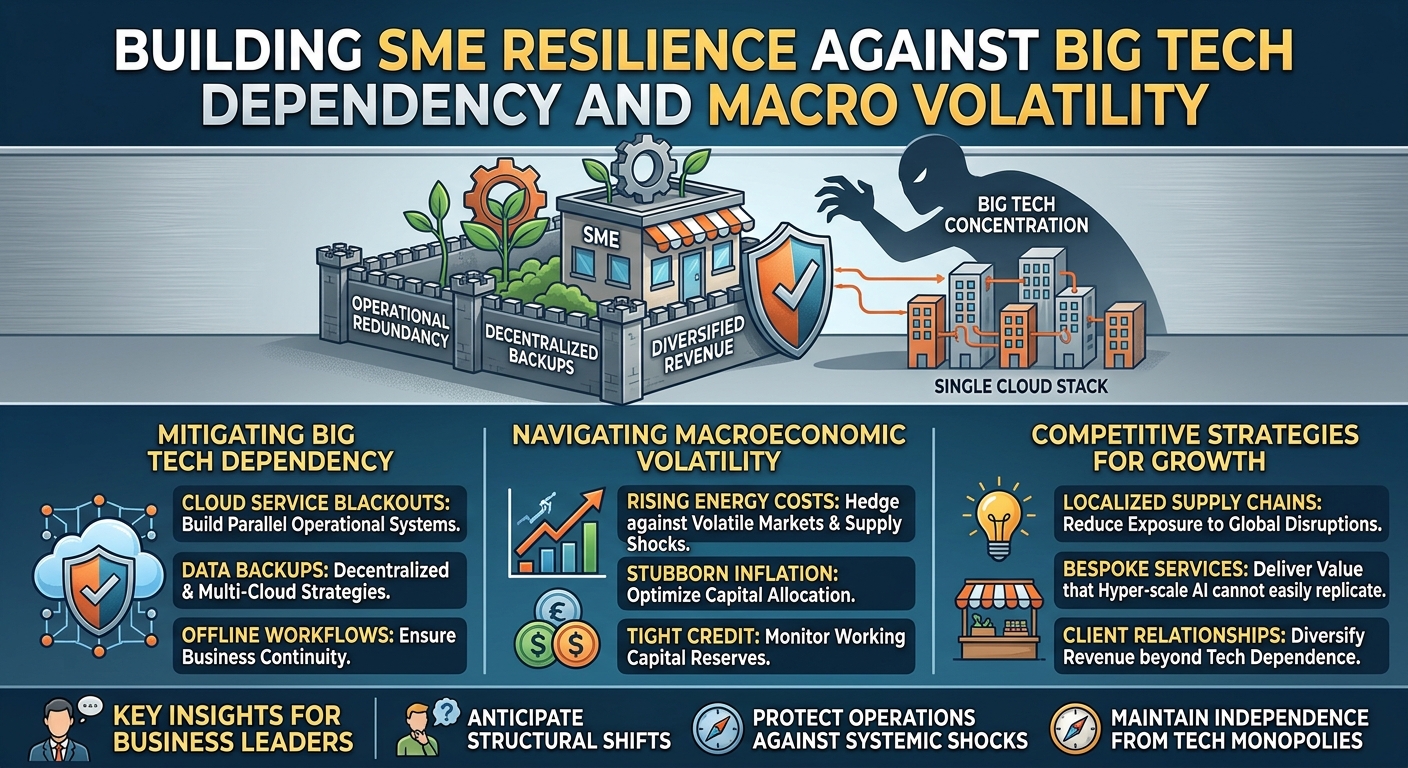
The global business landscape is shifting rapidly. With major technology equities facing intense scrutiny following leadership departures across artificial intelligence giants, enterprises can no longer rely on a single digital infrastructure stack. Recent operational disruptions, ranging from widespread cloud software outages to energy supply shocks driven by maritime escalations in the Strait of Hormuz, show that economic volatility requires robust operational backups. For business decision makers, the mandate is clear: build operational redundancy, hedge against rising inflation and borrowing costs, and establish a competitive moat independent of hyper scale tech conglomerates.
The Risks of Big Tech Dependency and Supercomputing Dominance
The centralization of computational power has reached unprecedented levels. While corporations race to adopt artificial intelligence, massive capital expenditures like multi billion dollar supercomputing campus investments by industry heavyweights signal a future dominated by mega scale infrastructure. Over the long run, as these tech giants build out private AI systems and autonomous ecosystems, smaller businesses risk being squeezed out or priced out of essential digital layers. Compounding this vulnerability is the fragility of centralized cloud ecosystems. Recent global server outages affecting enterprise tools like Microsoft 365 paralyzed operations for major airlines and corporate offices across multiple continents. Businesses that failed to maintain offline workflows or diversified cloud backups suffered immediate financial losses. Companies must recognize that relying exclusively on big tech platforms creates a dangerous single point of failure. Developing localized, independent operational workflows and parallel systems is essential to survival.
Macroeconomic Headwinds and Energy Pressures
Operational costs are climbing across every sector. Energy markets face renewed turbulence following shipping disruptions in the Strait of Hormuz, driving Brent crude prices higher and inflating logistics expenditures globally. Simultaneously, central banks grapple with stubborn inflation metrics, keeping interest rates elevated and tightening commercial credit conditions. In retail banking, heightened public anxiety and queuing for cash withdrawals reflect broader consumer unease amid shifting monetary policies. For growing businesses, these macro pressures mean that capital efficiency, working capital reserves, and localized supply chains must take precedence over high risk tech expansion.
Automotive Shifts and Market Dynamics
The competitive pressures facing traditional enterprises are mirrored in the consumer goods and automotive sectors. As governments re evaluate electric vehicle mandates and roll back aggressive targets following industry pushback, major automotive giants like Jaguar Land Rover and BYD are locked in intense intellectual property and market dominance disputes. For localized suppliers and independent businesses, handling these shifts requires agility and a diversified client base rather than tying fortunes to a single transitioning industry.
Strategic Adaptation for Modern Business Leaders
To compete effectively against dominant market players and insulate operations from systemic tech shocks, business leaders should implement several strategic priorities:
Build parallel operational systems by maintaining offline redundancies, decentralized data backups, and multi cloud strategies to ensure business continuity during major cloud service blackouts.
Diversify revenue beyond tech dependence by focusing on direct client relationships, bespoke service delivery, and localized market strengths that hyper scale AI models cannot easily replicate.
Optimize energy and overhead efficiency to mitigate exposure to volatile fossil fuel and utility markets by investing in energy saving protocols and localized power management.
Monitor capital allocation carefully to maintain strong cash reserves that buffer against high interest rates and tight credit availability while avoiding over leveraging into unproven digital fads.
As global policymakers and energy authorities gather at high level ministerial dialogues in Antalya, Turkey, to address climate finance and global electrification, the message for business leaders is unmistakable. Sustainable growth belongs to those who anticipate structural shifts, protect their operations against systemic shocks, and maintain independence from volatile tech monopolies. If your enterprise is evaluating risk management frameworks or seeking strategic advisory support for high value operational restructuring, contact the HPC advisory team today to review resilient commercial strategies.
Frequently Asked Questions for Australia SMEs and Enterprises on Operational Resilience and Big Tech Independence
1. How can SMEs and enterprises in Australia protect themselves from big tech concentration?
Businesses in Australia can reduce vulnerability to tech monopolies by implementing multi-cloud architectures, maintaining local offline data backups, and building proprietary client relationships that automated platforms cannot easily replicate.
2. Why is relying on a single cloud provider a major operational risk for companies in Australia?
Single-vendor dependency creates a dangerous single point of failure, meaning a widespread server outage or routing disruption at one tech giant can completely halt daily communications, billing, and customer service.
3. How does HPC help businesses in Australia build parallel operational backups alongside AI?
HPC advises leadership teams on structuring decentralized operational workflows, dual-vendor software stacks, and manual contingency protocols so core business functions continue running smoothly during digital blackouts.
4. What lessons should decision makers in Australia take from recent global Microsoft 365 and cloud outages?
Global disruptions prove that platform resilience is not the same as business resilience, requiring companies in Australia to establish alternative communication channels and documented offline procedures before an incident occurs.
5. How does the multi-billion-dollar supercomputing boom threaten smaller firms in Australia?
As mega-corporations invest tens of billions into massive private supercomputing campuses, smaller firms in Australia risk being priced out of high-end compute power or displaced by autonomous enterprise ecosystems unless they focus on specialised, high-touch value.
6. Can SMEs in Australia compete effectively against global corporations without matching their AI budgets?
Yes, agile enterprises in Australia can outperform slow-moving conglomerates by offering tailored service delivery, rapid local decision-making, and deep domain expertise that generic AI tools fail to match.
7. How does HPC assist Australia enterprises in reviewing their technology vendor dependencies?
HPC conducts commercial risk audits to map hidden supplier chains, identify critical operational bottlenecks, and negotiate flexible service agreements that prevent vendor lock-in.
8. Why is maintaining offline workflows important for businesses in Australia?
Offline workflows and local file repositories allow staff in Australia to continue processing orders, managing payroll, and serving clients even when external cloud networks go dark.
9. How can companies in Australia safeguard their intellectual property from large tech platforms?
Businesses in Australia should host sensitive proprietary data on private servers or ring-fenced enterprise instances rather than feeding confidential trade secrets into public AI models.
10. What role does leadership play in business continuity planning for Australia firms?
Continuity planning is a board-level commercial responsibility rather than just an IT task, requiring executives in Australia to define clear incident authority and pressure-test emergency responses regularly.
11. How do rising global energy prices affect operating margins for businesses in Australia?
Geopolitical tensions and maritime shipping disruptions drive up crude oil and electricity costs, forcing companies in Australia to absorb higher utility and logistics overheads unless they actively hedge or improve efficiency.
12. How can HPC help enterprises in Australia mitigate exposure to energy price shocks?
HPC helps businesses in Australia evaluate capital allocation for on-site energy efficiency upgrades, supply chain localization, and commercial restructuring to protect profit margins against utility volatility.
13. Why are elevated interest rates forcing Australia SMEs to rethink their growth strategies?
Higher borrowing costs reduce financial headroom and make debt-funded expansion expensive, prompting business leaders in Australia to prioritize cash-generative projects and strict working capital discipline.
14. How can companies in Australia protect liquidity during periods of banking sector unease?
Enterprises in Australia should diversify their banking relationships across multiple Tier 1 institutions and maintain accessible cash reserves to avoid operational paralysis during localized liquidity crunches.
15. What commercial strategies help Australia manufacturers handle shifting electric vehicle mandates?
Suppliers in Australia can reduce risk by diversifying their client portfolios across hybrid, internal combustion, and industrial sectors rather than relying solely on rigid government electric vehicle timelines.
16. How do intellectual property disputes between global automotive giants impact Australia businesses?
High-profile patent battles between major automakers highlight the need for companies in Australia to audit their own supply chains and ensure component partners hold clear, undisputed design rights.
17. How does HPC support Australia firms in diversifying their supply chains?
HPC connects enterprises in Australia with vetted international manufacturing partners and regional logistics hubs to reduce over-reliance on single-country or vulnerable maritime trade routes.
18. Why should Australia decision makers avoid over-leveraging into unproven digital trends?
19. How can businesses in Australia train staff to handle sudden technology blackouts?
Companies in Australia should run regular simulation drills using non-cloud communication tools like SMS or secondary messaging apps so teams know exactly how to execute critical tasks under pressure.
20. What are the warning signs that an enterprise in Australia is overly dependent on big tech?
Warning signs include having all employee communications, customer databases, and authentication systems tied to a single cloud provider with zero independent failover pathways.
21. How does HPC help Australia companies structure strategic partnerships to gain scale?
HPC advises SMEs in Australia on forming joint ventures, strategic alliances, and targeted acquisitions that combine resources and increase bargaining power against larger rivals.
22. How can Australia businesses protect against phishing and cyber threats during major tech outages?
Outages often trigger waves of fraudulent IT support messages, so firms in Australia must enforce strict multi-factor authentication and verify all password reset requests through separate offline channels.
23. Why is localized market knowledge a major advantage for Australia SMEs?
Deep understanding of local regulations, cultural nuances, and regional customer preferences enables businesses in Australia to deliver tailored solutions that standardized global platforms overlook.
24. How do global climate finance and electrification policies affect SMEs in Australia?
International ministerial agreements accelerate regulatory shifts toward clean energy, creating both compliance pressures and new funding opportunities for businesses in Australia that modernize early.
25. How can HPC assist Australia enterprises in accessing alternative growth capital?
HPC connects established businesses in Australia with private equity funds, family offices, and institutional investors seeking resilient, asset-backed companies outside traditional bank lending.
26. What immediate steps can a Australia SME take to lower energy overheads without heavy capital outlay?
Companies in Australia can achieve quick savings by conducting internal energy audits, optimizing heating and lighting schedules, and eliminating idle machinery power draw.
27. How does multi-cloud adoption work in practice for mid-sized firms in Australia?
Mid-sized firms in Australia can split workloads by hosting primary applications on one cloud platform while maintaining automated, daily replicated backups and emergency workspace tools on a completely separate provider.
28. Why is customer data ownership critical for Australia businesses using third-party software?
Retaining full export rights and independent copies of customer records ensures that a company in Australia can migrate operations quickly if a software vendor raises prices steeply or suffers prolonged downtime.
29. How can Australia enterprises stress-test their financial plans against macroeconomic shocks?
Finance teams in Australia should model scenarios combining a 20 percent spike in energy costs, prolonged high interest rates, and a temporary revenue dip to verify cash runway resilience.
30. How does HPC help Australia founders prepare their businesses for strategic exits or mergers?
HPC structures commercial operations, strengthens governance, and eliminates single-vendor vulnerabilities so companies in Australia command higher valuations from institutional buyers.
31. What role do physical assets play in protecting Australia business wealth during inflation?
Investing surplus corporate capital into tangible commercial real estate or productive machinery provides an inflation hedge and stable collateral value that digital subscriptions cannot offer.
32. How can Australia retail and service businesses maintain customer trust during digital disruptions?
Maintaining transparent offline communication plans, flexible payment acceptance options, and responsive human support reassures clients in Australia when automated systems fail.
33. Why should Australia executives review vendor Service Level Agreements carefully?
Standard cloud contracts rarely compensate businesses for lost revenue during outages, meaning leaders in Australia must build internal operational buffers rather than relying on vendor rebates.
34. How can SMEs in Australia use selective automation without losing human control?
Businesses in Australia can deploy targeted tools for repetitive back-office tasks while keeping human experts in charge of client strategy, quality assurance, and final decision-making.
35. How does HPC advise Australia firms on cross-border expansion into stable markets?
HPC evaluates regulatory environments, tax structures, and local partner networks to help enterprises in Australia diversify revenue streams across multiple geographic regions.
36. What is the danger of leadership instability at major tech suppliers for Australia clients?
Sudden executive departures or strategic pivots at dominant tech firms can lead to abrupt product discontinuations or pricing changes, making vendor diversification essential for Australia buyers.
37. How can Australia companies protect their supply chains from geopolitical chokepoints?
Enterprises in Australia can reduce transit risks by holding strategic buffer inventory locally and qualifying secondary suppliers located closer to their end markets.
38. Why is cash flow visibility more important than rapid top-line growth in volatile markets?
Strong cash flow visibility allows leaders in Australia to fund operations internally, avoid punitive short-term borrowing, and acquire distressed competitors when market conditions tighten.
39. How can Australia businesses verify the resilience of their key software partners?
Decision makers in Australia should request independent security certifications, inspect historical uptime logs, and verify whether critical vendors rely on the exact same underlying cloud infrastructure.
40. What makes bespoke advisory superior to automated business tools for Australia executives?
Experienced commercial advisors provide tailored strategic judgment, negotiation leverage, and confidential network access that algorithmic platforms cannot replicate.
41. How can Australia enterprises reduce costs associated with legacy IT bloat?
Conducting quarterly software audits helps firms in Australia eliminate unused enterprise licenses and redirect capital toward core operational resilience and staff training.
42. Why is retaining skilled human talent vital in an era of corporate AI concentration?
Experienced employees possess institutional memory, creative problem-solving skills, and trusted client relationships that allow Australia businesses to adapt rapidly when automated systems break down.
43. How can Australia manufacturers protect profit margins when raw material costs fluctuate?
Manufacturers in Australia can incorporate dynamic pricing clauses into long-term contracts and improve production energy efficiency to cushion against sudden input price spikes.
44. How does HPC help Australia companies structure buy-side acquisitions of vulnerable competitors?
HPC identifies undervalued peers facing operational or succession pressures and structures disciplined acquisitions that expand market share for resilient Australia enterprises.
45. What contingency steps protect payroll and finance operations during an IT blackout?
Finance teams in Australia should keep encrypted offline copies of payment schedules and establish pre-authorized manual banking protocols with their relationship managers.
46. How can Australia businesses leverage sustainability improvements to win corporate contracts?
Demonstrating measurable reductions in energy consumption and carbon intensity helps SMEs in Australia meet the strict procurement standards of large international corporate buyers.
47. Why should Australia decision makers separate identity management from primary cloud storage?
Using an independent identity and access management provider ensures that staff in Australia are not locked out of secondary backup tools if their main workspace suite experiences an outage.
48. How can Australia firms build strong direct distribution channels independent of tech gatekeepers?
Investing in proprietary customer databases, direct sales teams, and owned digital properties protects businesses in Australia from sudden algorithm changes or rising platform fees.
49. What criteria does HPC use when assessing operational resilience for Australia clients?
HPC evaluates vendor concentration, liquidity headroom, energy exposure, supply chain flexibility, and governance clarity to build comprehensive commercial protection plans.
50. How can business leaders in Australia initiate a confidential resilience and strategy review with HPC?
CEOs, founders, and board directors in Australia can contact the HPC advisory team directly to arrange a confidential consultation tailored to their specific sector and operational goals.