When institutional investors, private equity funds, and corporate buyers evaluate high-value cross-border acquisitions within the European financial sector, securing premier transaction assets requires managing complex regulatory standards, confidentiality protocols, and strict buyer liquidity verification. Recent sell-side mandates involving private banking portfolios in Europe highlight the rigorous protocols governing financial asset transfers. These opportunities demand sophisticated sell-side advisory, transparent buyer credentialing, and strict adherence to non-disclosure frameworks. HPC Consultancy Ltd provides independent commercial advisory and transaction structuring for institutional buyers, private equity funds, and enterprise owners managing these capital-intensive financial acquisitions.
Managing High-Stakes Financial M&A and Confidentiality
Executing a complete acquisition of a private financial institution or retail bank requires rigorous financial due diligence, legal verification, and tailored transaction structuring under strict non-disclosure agreements. Because banking assets involve sensitive customer data, proprietary deposit structures, and strict regulatory oversight, sellers require immediate buyer liquidity verification before releasing confidential information memorandums or detailed asset dossiers. Through our trusted partner network, HPC connects vetted institutional capital with premium banking acquisition targets designed to deliver exceptional long-term capital appreciation and strategic market expansion in Europe.
Key Structural Requirements and Deal Mechanics
For institutional investors and family offices seeking exposure to European financial services, high-value banking assets offer compelling market entry and predictable operational cash flows.
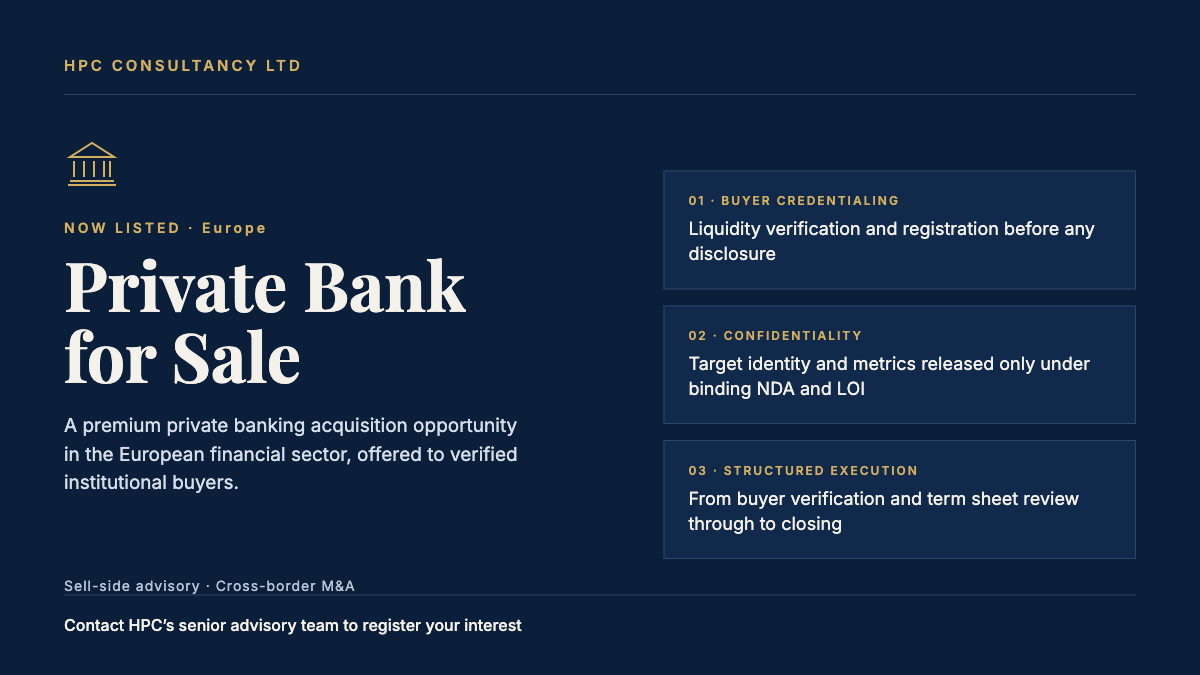
Strict buyer credentialing requires mandatory liquidity verification and formal registration protocols prior to the disclosure of sensitive portfolio data and underlying customer information.
Confidentiality and letter of intent protocols ensure that detailed asset profiles, institutional metrics, and target identities are released strictly under binding agreements because of sensitive customer privacy regulations.
Rapid transaction execution relies on structured sell-side processes designed to move efficiently from initial buyer verification and preliminary term sheet review to final closing.
Strategic Sell-Side and Buy-Side Advisory
Executing complex cross-border banking transactions demands rigorous financial engineering, regulatory compliance audits, and strict confidentiality controls. HPC assists corporate developers, institutional buyers, and private equity funds in managing every stage of the investment lifecycle.
Direct access to vetted deal flow connects institutional buyers with exclusive financial assets across key European jurisdictions while protecting all sensitive commercial data and counterparty identities.
Regulatory and liquidity verification manages buyer credentialing, proof of funds, and compliance protocols to satisfy seller requirements smoothly and securely.
Disciplined process control implements strict staged information security, blind teasers, and controlled virtual data room access to preserve operational integrity during banking asset transfers.
If your enterprise or fund is evaluating European financial sector investments or seeking active advisory support for high-value M&A mandates, contact HPC today to connect with our senior advisory team.
Frequently Asked Questions for Australia Institutional Buyers on European Banking Acquisitions
1. How does HPC assist institutional buyers from Australia in acquiring European private banking assets?
HPC provides independent commercial advisory, buyer credentialing, and transaction structuring, enabling institutional buyers from Australia to access vetted financial assets across key European jurisdictions.
2. Why are European private banking portfolios attractive to institutional investors from Australia?
European private banking assets provide investors from Australia with stable, euro-denominated fee income, capital preservation, and direct access to established wealth management client bases.
3. What is the typical valuation range for private banking acquisitions in markets like Europe?
Target valuations vary based on asset quality and portfolio size, with premium private banking mandates typically structured around multi-hundred-million-euro benchmarks.
4. Why is immediate liquidity verification mandatory for buyers from Australia prior to receiving detailed dossiers?
Because financial institutions handle highly sensitive customer data and proprietary deposit structures, sellers require verified proof of funds to protect market stability and customer privacy.
5. How do HPC partners manage cross-border regulatory compliance for buyers from Australia?
HPC partners collaborate with European financial regulators and legal specialists to ensure buyers from Australia satisfy all statutory ownership, anti-money laundering, and capital adequacy requirements.
6. What role does a Letter of Intent play in securing private banking assets in Europe?
A formal Letter of Intent establishes binding confidentiality terms, preliminary transaction parameters, and exclusivity windows required to initiate staged information release.
7. Can private equity funds from Australia acquire full equity control of Italian private banks?
Yes, private equity funds and corporate buyers from Australia can acquire majority or 100 percent equity ownership subject to regulatory approval from national banking authorities.
8. How does HPC defend valuation metrics during buy-side due diligence for Australia acquirers?
Advisors review historical net interest margins, fee income resilience, assets under management, and operational expenditure to ensure buyers from Australia enter at fair valuations.
9. What safeguards protect target bank customers while buyers from Australia evaluate confidential data?
Staged virtual data rooms and anonymized asset profiles prevent public market speculation and customer churn while Australia buyers review financial metrics.
10. How long does the transaction lifecycle usually take for European banking M&A deals?
While initial buyer verification moves rapidly, complete regulatory clearance and deal execution typically take between three to six months.
11. Can family offices from Australia participate in European financial asset acquisitions?
Yes, multi-family offices and private investment consortia from Australia can acquire targeted banking assets or participate in structured co-investments.
12. What role do advisory provisions play in cross-border banking acquisitions?
Standard transaction provisions cover sell-side and buy-side deal facilitation, regulatory filing support, and process management upon successful closing.
13. How does HPC handle non-disclosure protocols for institutional buyers from Australia?
HPC enforces strict staged non-disclosure agreements, releasing non-public memorandums only after verifying buyer credentials and executive authorization.
14. What are the key operational drivers for value creation post-acquisition in European banks?
Buyers from Australia can drive value by digitalizing wealth management tools, optimizing middle-office costs, and cross-selling international corporate services.
15. Are retail banks in Southern Europe structured differently from private wealth managers?
Retail banks focus heavily on branch networks, consumer deposits, and mortgage lending, whereas private banks prioritize high-net-worth wealth management and fee-based revenue.
16. How do HPC partners support Australia buyers during regulatory change of control filings?
Advisors assist buyers from Australia in preparing comprehensive fit and proper documentation, capital plan submissions, and governance structures for central bank approval.
17. How do foreign currency fluctuations affect euro-denominated banking returns for Australia investors?
Holding euro-denominated assets allows buyers from Australia to diversify currency exposure, while foreign exchange hedging strategies mitigate short-term volatility.
18. What due diligence steps are performed on loan portfolios of target European banks?
Independent audits evaluate non-performing loan ratios, collateral valuation accuracy, credit concentration risks, and provision adequacy for Australia buyers.
19. Can buyers from Australia retain existing management teams post-acquisition?
Yes, retaining experienced local executive teams and licensed compliance officers is frequently favored by European regulators to ensure operational continuity.
20. How does HPC verify seller authority before presenting deal opportunities to Australia funds?
HPC conducts background verification and confirms mandate agreements with primary shareholders or appointed corporate representatives before circulating teasers.
21. What capital adequacy standards must Australia buyers maintain post-acquisition?
Acquiring institutions must maintain statutory Basel III/IV capital buffers, Tier 1 capital ratios, and liquidity coverage requirements enforced by European central banks.
22. How are non-disclosure breaches prevented during international deal promotion?
Strict protocol limits information access to authorized personnel, utilizing watermark-tracked documents and secure virtual data rooms to prevent unauthorized dissemination.
23. What role does digital transformation play in modern European banking acquisitions?
Upgrading legacy banking infrastructure with modern cloud and AI frameworks allows acquirers from Australia to cut operating ratios and scale client service.
24. Can institutional buyers from Australia acquire non-performing asset portfolios separately?
Yes, specialized asset management vehicles from Australia can acquire carve-out loan portfolios or distressed asset divisions under targeted transaction frameworks.
25. How do European consumer data laws like GDPR impact due diligence for Australia acquirers?
Data protection laws mandate strict anonymization of personal client records during due diligence, permitting unmasked data review only after transaction completion.
26. How are transaction funds transferred securely during international financial asset sales?
Funds are processed through Tier 1 European escrow banks, releasing equity payments to sellers only upon final regulatory clearance and registry transfers.
27. What interest rate environment factors should Australia buyers consider in European banking?
Prevailing central bank interest rate policies impact net interest margins, making asset-liability management a central focus during financial modeling.
28. How do HPC partners evaluate the deposit stability of a target Italian bank?
Advisors review deposit granularity, historical retention rates, corporate versus retail deposit ratios, and sensitivity to competitive rate shifts.
29. Can acquirers from Australia integrate acquired European banks into international financial hubs?
Yes, cross-border banking groups frequently link European wealth desks with global financial hubs to capture international trade flows and wealth management mandates.
30. What legal frameworks govern target bank employee transfers in Europe?
European labor regulations protect existing staff contracts during corporate transfers, requiring acquirers from Australia to follow clear consultation processes.
31. How does HPC structure blind teasers for sensitive European financial sales?
Blind teasers outline key financial metrics, asset scale, and growth trajectory without disclosing company names, precise locations, or identifying client details.
32. What secondary market options exist for Australia buyers seeking exit liquidity?
Acquirers can exit via strategic platform sales to larger banking conglomerates, secondary buyouts by international private equity, or public stock listings.
33. How do HPC partners assist in auditing off-balance-sheet items?
Advisors evaluate contingent liabilities, outstanding guarantees, derivative positions, and pending litigation to safeguard buying entities from Australia.
34. What tier of financial institutions does HPC focus on for cross-border mandates?
HPC focuses primarily on mid-tier private banks, independent wealth managers, specialized commercial lenders, and high-yield financial services providers.
35. Can investors from Australia form buyer syndicates to acquire larger European banks?
Yes, HPC helps structure joint bidding consortia, allowing multiple institutional investors from Australia to pool capital and split equity stakes cleanly.
36. How are corporate governance structures adapted for non-European parent companies?
Target bank boards are structured to include independent local directors to satisfy European governance requirements while providing parent oversight.
37. What impact do ESG standards have on European banking valuation?
Strong environmental, social, and governance frameworks enhance bank ratings, lower compliance risks, and attract institutional capital seeking sustainable assets.
38. How do HPC partners verify the origin of capital for international acquirers?
Advisors assist buyers from Australia in preparing clear audit trails, corporate ownership charts, and source of funds documentation required by anti-money laundering authorities.
39. What software platforms are utilized for secure financial document sharing?
Enterprise-grade virtual data rooms with multi-factor authentication, dynamic watermarking, and restricted download permissions protect all deal documentation.
40. Can acquirers from Australia restructure branch networks after completing an acquisition?
Subject to regulatory consultation, buyers can optimize physical branch footprints, transitioning toward digital-first service delivery models to lower overheads.
41. How does HPC assist in negotiating purchase price adjustments during closing?
Advisors structure completion accounts or locked-box mechanisms to adjust final purchase considerations based on working capital and net debt at closing.
42. What insurance protection is available for buyers during European M&A transactions?
Warranty and Indemnity insurance policies can be secured to cover unexpected tax liabilities or breaches of seller warranties, protecting buyer equity.
43. How do private banking profit margins in Europe compare with broader European averages?
Italian private wealth management features high client loyalty and solid fee margins, driven by substantial domestic wealth concentration and specialized advisory demand.
44. What steps ensure smooth operational migration after closing a banking purchase?
Transition service agreements ensure IT systems, clearing connections, and back-office services continue running seamlessly while new systems are integrated.
45. How does HPC evaluate tax efficiency for cross-border banking acquisitions?
Advisors coordinate with tax specialists to select holding jurisdictions and corporate structures that optimize dividend flows and capital gains treatment.
46. Can buyers from Australia acquire asset management subsidiaries separately from parent banks?
Yes, carve-out transactions allow buyers from Australia to acquire specific fee-generating asset management divisions without acquiring underlying banking liabilities.
47. What role do independent valuation opinions play in board approvals for Australia buyers?
Fairness opinions from independent valuation experts provide board members and LPs with objective verification of transaction pricing fairness.
48. How do European central bank stress tests influence target selection?
Reviewing target bank performance under official stress test scenarios helps buyers from Australia assess capital resilience against adverse economic shocks.
49. What communication protocols prevent market rumors during sensitive deal talks?
Strict communication protocols restrict knowledge of discussions to core deal teams, utilizing code names for project stakeholders until binding agreements sign.
50. How can institutional buyers from Australia initiate a confidential banking M&A discussion with HPC?
Institutional leaders and fund managers can contact the central HPC advisory team directly to review qualified financial mandates and establish acquisition criteria.